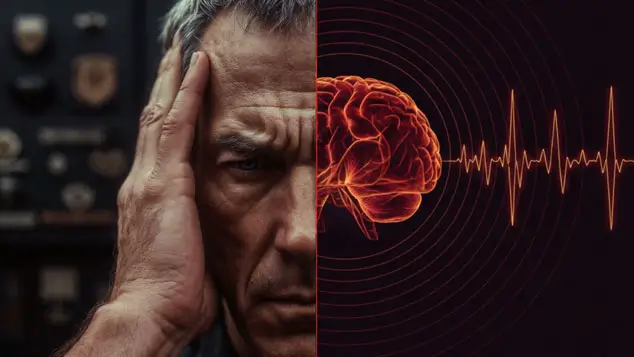
You Did Everything Right. The Ringing Didn't Care.
You filed the claim. You sat through the C&P exam. You got rated 10%.
You thought that was the beginning of help.
Then the insomnia got bad enough that you filed again — secondary to tinnitus. Sleep destroyed by the ringing. Waking up 2, 3 times a night even with a fan running. Your wife losing patience. Your focus at work slipping.
Denied. "Not service-connected." Not appealable.
The letter came. You read it twice. And that night, the ringing was louder than it had been in months.
That wasn't coincidence. Stress drives the signal up. The neurology is documented — the VA just doesn't rate it that way.
So here you are. Rated. Not helped. Searching again.
Before you give up or spend another $89 on something that won't work — you need to understand what's actually happening. Not in your ear. In your brain.
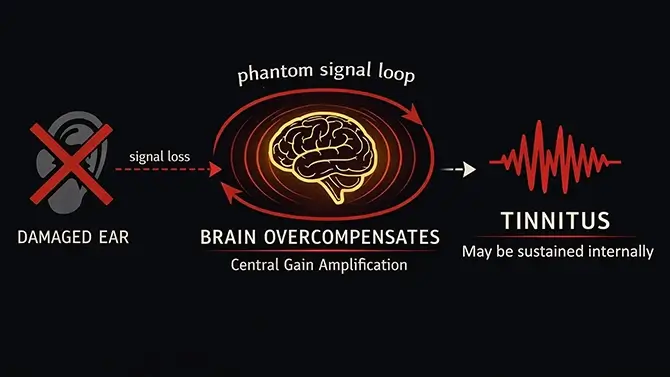
The problem isn't in your ear anymore. It's in the circuit.
When noise damages the ear, the brain adapts — it turns up its internal gain to compensate for the lost signal.
In many chronic cases, that amplified signal continues even after the original injury has stabilized. The ear stopped receiving the blast years ago. The brain is still reacting to it.
This explains three things veterans report that doctors can't explain:
- Why it gets louder at night. When external sound drops, the brain has no competing input — it fills the silence with the amplified phantom signal.
- Why stress makes it spike. Elevated cortisol increases neural sensitivity across the board. A stressful event — like a VA denial letter — can trigger a measurable spike in how intensely the phantom signal is perceived.
- Why the audiogram shows nothing. Standard hearing tests measure incoming sound. They don't measure the brain's internal gain setting. Two different systems.
Traditional medicine targeted the ear.
If the source is the brain's gain circuit — treating only the ear was never going to be enough.
Every Treatment Missed The Actual Problem.
If you've already tried something and it didn't work, there's a reason — and it's not that you did anything wrong.
None of these are failures of your effort. They're failures of targeting. If the problem is neural gain — the solution has to address neural gain.
You're Not the Only One the VA Left Without Answers.
"I was granted 30% for insomnia secondary to tinnitus for a few months. Then the VA took it away — said it was an erroneous decision to compensate insomnia as secondary to tinnitus. The letter also stated this decision was not appealable."— @kanehill7697 · YouTube, VA Benefits Channel · Verified comment
"VA at it again. Filed an increase for tinnitus due to dizziness, falling. VA sent me letters requesting help getting the audiology report — the one they paid for. Why isn't that report in my VA records? Don't even get me started."— Timothy J.B. · Facebook Veterans Group · Public post
The frustration in those posts isn't weakness. It's the entirely rational response of a man who served, got damaged, and watched the institution that was supposed to help close every door.
The question worth asking now isn't "why did the VA fail me" — it's "what did the VA's approach miss about how this actually works."
They weren't the exception. They were the pattern.
See What The VA's Protocol Never Addressed →Does This Sound Like Your Last 6 Months?
In chronic cases, the pattern becomes predictable. Check how many of these match your experience:
If three or more of these match — this isn't random. It's a neurological pattern. And a pattern has a mechanism.
What Research Documents About Chronic Tinnitus & Sleep.
No drug eliminates tinnitus. But in persistent cases, research increasingly points to altered neural signal processing — and its direct impact on sleep architecture.
Research describes a self-reinforcing cycle: Phantom signal → broken sleep → elevated stress → higher neural gain → louder ringing → worse sleep → repeat.
Breaking that cycle requires addressing the gain mechanism — not just the symptoms it produces.
What Men In Your Situation Actually Want To Know.
More common than the VA acknowledges. The neurological connection between tinnitus and sleep disruption is well-documented in research — but VA raters frequently treat the two as separate conditions.
The phantom signal loop that causes chronic tinnitus directly interferes with the brain's ability to downregulate for sleep. They are not independent problems — they share the same neural mechanism. The VA's current rating framework doesn't reflect that research.
When external sound drops, the brain has less competing input to process. In chronic cases, it increases internal sensitivity to fill the gap — which makes the phantom signal more noticeable in silence.
That's why the fan helps somewhat, but doesn't solve it. The background noise reduces the contrast — it doesn't change the brain's gain setting.
Stress elevates cortisol. Elevated cortisol increases neural sensitivity — including in the auditory pathways already running at amplified gain.
A high-stress event doesn't cause new damage. It makes the existing phantom signal louder by raising the sensitivity threshold. Veterans commonly report this pattern after confrontations with the VA, family conflict, or work pressure.
Hearing tests measure incoming external sound — they evaluate the ear. They don't measure how the brain processes internal signals or what gain level it's operating at.
In long-term tinnitus, the issue has often shifted from the ear to the auditory processing system. A normal audiogram doesn't rule out a neurological pattern. It just means the ear test didn't find it — because it wasn't looking in the right place.
Duration doesn't determine outcome. The brain retains neuroplasticity throughout life — the same adaptability that created the phantom signal can, in many cases, support a gradual recalibration.
Chronic patterns take longer to shift than acute ones. But the research on long-term cases doesn't support the idea that time alone closes the door.
The VA Closed The Door. The Ringing Didn't.
If you're still hearing it after years of ratings, denials, and treatments that didn't work — there's a reason. And it has nothing to do with how severe your service was.
No miracle claims. No instant-silence promises. Just the mechanism — and what current neurology research suggests about interrupting it.
Most veterans who discover this explanation report the same reaction: they wish someone had explained it years earlier — before the sleep loss and stress cycles became permanent.
What The VA's Audiologist Didn't Explain →No supplements · No purchase required · Just the explanation